Subterranean termites cause the vast majority of structural wood destruction across Broward County, entering buildings directly from subterranean nests containing up to several million workers. Properties along the…
Subterranean termites cause the vast majority of structural wood destruction across Broward County, entering buildings directly from subterranean nests containing up to several million workers. Properties along the South Ocean Drive corridor, Golden Isles, and Three Islands face persistent pressure because a shallow water table forces subterranean termite colonies closer to ground level, accelerating their migration into dry framing through hairline foundation cracks as small as 1/32 of an inch. Store-bought repellents fail because subterranean workers avoid treated surface areas and construct new mud tubes around them, leaving the core subterranean colony intact. A legitimate barrier treatment uses non-repellent transfer chemistry like fipronil or imidacloprid at an application volume of 4 gallons per 10 linear feet, so workers ingest and spread the toxicant through social grooming back to the reproductive queen.
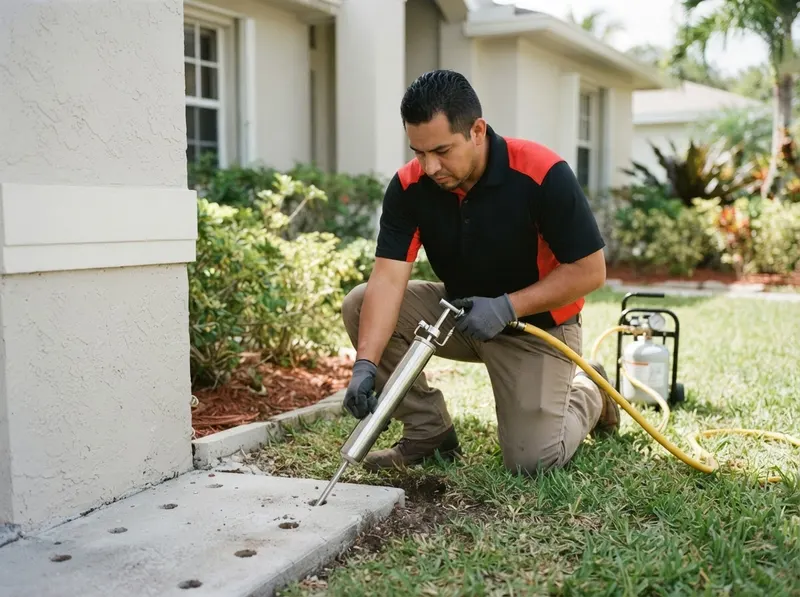
Treatment selection separates into liquid trench barriers and subterranean bait networks. Liquid treatments apply to continuous soil along perimeters in Foster Park, Ingalls Park, and Chula Vista, establishing immediate chemical protection zones that persist for 5 to 10 years depending on rainfall runoff and soil saturation. In high-density settings like the Diplomat Golf & Tennis Club area or Hallandale Heights where zero-lot lines, patio pavers, or finished driveways surround exterior walls, targeted masonry drilling at 12-inch intervals injects termiticide directly beneath the slab. Alternatively, exterior bait stations placed every 10 to 15 feet around a perimeter provide ongoing population suppression by delivering chitin synthesis inhibitors, though complete colony collapse via bait stations generally requires 60 to 120 days compared to the rapid interruption provided by liquid soil injections.
Subterranean termite treatment differs fundamentally from drywood termite treatments. Subterranean termites require continuous contact with soil moisture to prevent desiccation and cannot survive purely within aerial framing, meaning structural tent fumigation leaves underground colonies unharmed to rebuild mud tubes weeks later. Conversely, a soil barrier isolates the colony from the wood source, suffocating the colony's supply lines. Homeowners can reach service dispatch directly at (239) 695-8601 to confirm scheduling and site inspections without multi-year contract mandates.
Every job gets a firm, written price after a free on-site visit.
Tell us about your subterranean termite treatment job in Hallandale Beach and we'll send a clear, written quote, usually the same day.
 Red Rooster Pest Control