Roof rats are arborists by nature, exploiting South Florida palm canopies, utility spans, and tile overhangs along the South Ocean Drive corridor and Golden Isles to slip through gaps as small as 0.5 inches into…
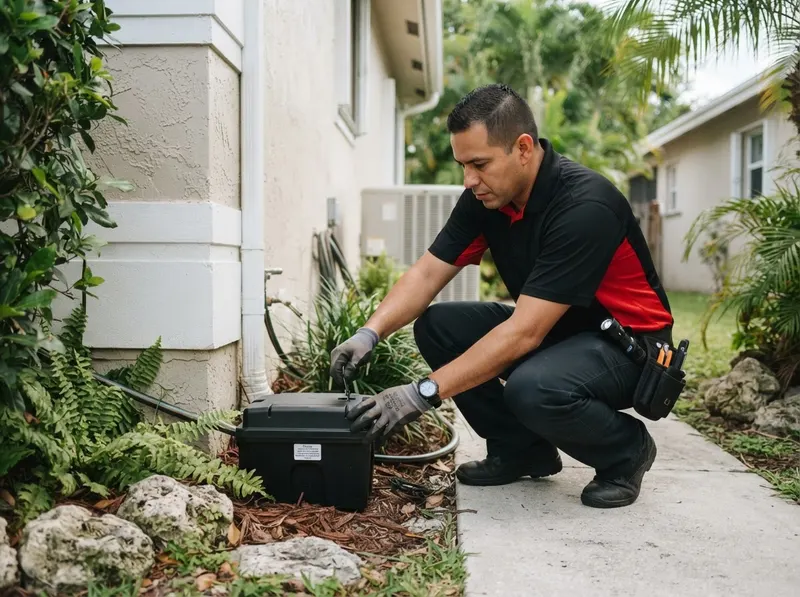
Roof rats are arborists by nature, exploiting South Florida palm canopies, utility spans, and tile overhangs along the South Ocean Drive corridor and Golden Isles to slip through gaps as small as 0.5 inches into soffits and ceiling voids. Off-the-shelf snap traps and consumer rodenticides fail because they merely thin foraging populations without blocking access points or eliminating the pheromone runways inside multi-family utility shafts. Standard pest maintenance agreements frequently bypass heavy structural repairs, relying solely on exterior bait stations that leave attic nests intact. In high-density settings like Three Islands and Hallandale Heights, an unsealed weep screed or roof return allows rodents to transit continuously between units, compromising wiring, ductwork, and ceiling drywall.
Effective rodent eradication mandates a clear separation between containment and structural defense. In properties adjoining salt-canal corridors and dense landscaping around the Diplomat Golf & Tennis Club area and Foster Park, Norway rats target ground foundations, seawall recesses, and low plumbing breaches, while roof rats monopolize higher elevations. Properties with attic AC air handlers require specialized metal flashing, 0.25-inch galvanized hardware cloth, and elastomeric sealants that resist rodent incisors. If an infestation is localized inside a 900-square-foot Chula Vista bungalow, localized mechanical trapping combined with direct foundation sealing secures the footprint. If a two-story waterfront residence in Golden Isles features complex barrel-tile rooflines, full perimeter exclusion is non-negotiable; closing access paths leaves remaining rodents no option but mechanical capture stations.
The trade-off between exterior poison stations and non-toxic mechanical trapping inside attic boundaries centers on containment safety. Chemical poisons placed within interior walls frequently cause rodent mortality inside enclosed structural cavities, creating persistent odors and secondary blowfly infestations under intense coastal humidity. Mechanical trapping inside conditioned boundaries, paired with exterior tamper-resistant harborage stations, provides verified corpse removal, eliminates toxic hazards to indoor pets, and prevents carcass entrapment inside interior partition walls.
Every job gets a firm, written price after a free on-site visit.
Tell us about your rodent control job in Hallandale Beach and we'll send a clear, written quote, usually the same day.
 Red Rooster Pest Control